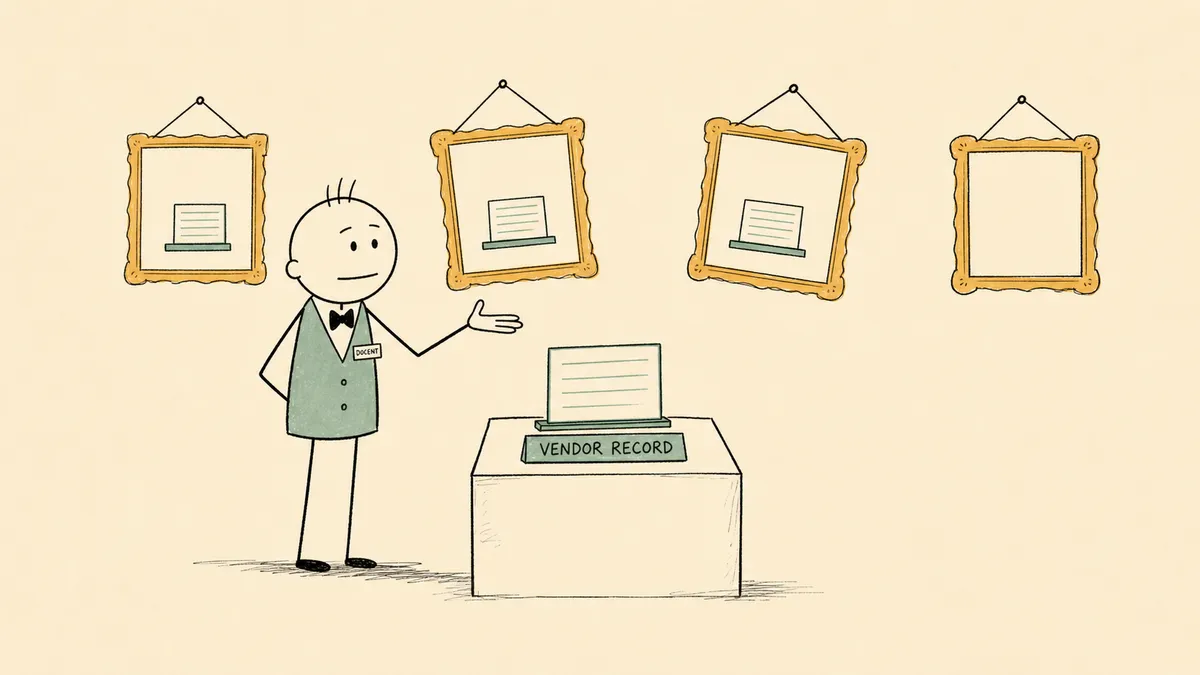
Vendor onboarding is the process a company uses to collect, check, and approve a new vendor’s information before buying from or paying that vendor. It covers the vendor’s legal and tax details, its banking information, proof of insurance, the contract, and the internal approvals. It ends with the vendor set up in your accounting or ERP system, so someone can issue a purchase order and AP can pay the invoice. It starts when a person in the business asks for a new vendor, and it is finished when that vendor can transact.
This page covers what vendor onboarding includes, how it differs from supplier onboarding and from sourcing, why it matters, and who owns each part. If you want the steps in order with a document checklist, read the supplier onboarding process. If you already run a process and want to tighten it, read supplier onboarding best practices.
What vendor onboarding includes
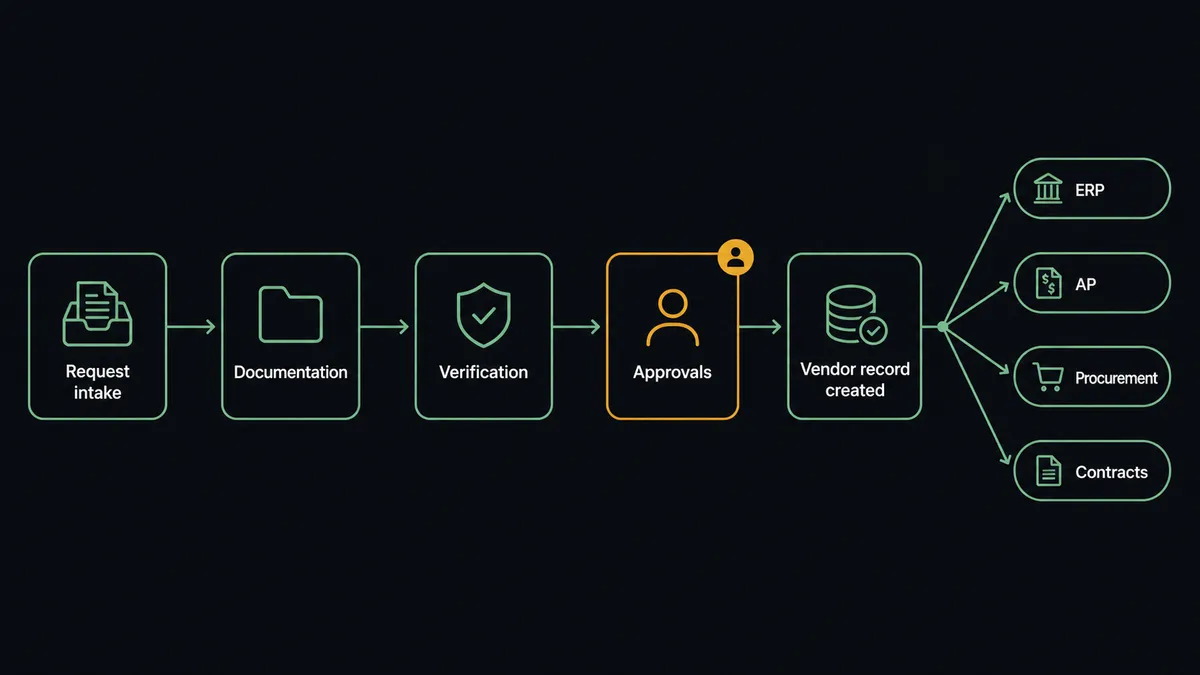
Every company words it differently, but the work falls into five stages:
- Request. Someone in the business needs a new vendor and says why, for what, and roughly how much spend.
- Information and documents. The vendor provides its legal name, tax ID, banking details, and the documents your policy requires for that kind of vendor.
- Verification. Your team checks what came in: the tax ID matches the name, the vendor is not on a sanctions list, the bank account belongs to the vendor.
- Approvals. Procurement, finance, legal, and sometimes IT sign off on the parts they own.
- Vendor record created. AP sets the vendor up in the ERP or accounting system with payment terms and a payment method.
The documents themselves are short for most vendors. A US vendor gives you a Form W-9, and a foreign vendor gives you a W-8 series form instead. Banking details and a certificate of insurance complete the basics. Higher-risk vendors add more, such as a security report or a signed data processing agreement. The full checklist, organized by risk level, is in the process guide.
Vendor onboarding vs supplier onboarding
Most companies use the two terms for the same process, and so does this site. When people do draw a line, it runs like this. Vendor onboarding is the administrative and financial setup for anyone you pay, whether they sell you software, legal services, or office chairs. Supplier onboarding adds operational readiness for companies that supply goods, such as order formats, delivery standards, and quality requirements.
Onboarding also sits between two other jobs that get lumped in with it:
| Sourcing | Vendor onboarding | Vendor management | |
|---|---|---|---|
| Question it answers | Which vendor should we use? | Can we safely pay and work with this vendor? | Is this vendor still performing and compliant? |
| Starts when | A need is identified | A vendor has been chosen | The vendor is live |
| Ends when | A vendor is selected | The vendor can receive a PO and be paid | The relationship ends |
| Typical owner | Procurement or the business | Procurement, with finance, legal, and IT | Procurement or the business owner |
Keeping these apart matters in practice. Onboarding does not reopen the choice of vendor, and it does not own performance reviews. It does own the handoff to vendor management. Expiration dates, renewal terms, and contacts collected during onboarding have to land somewhere the next team will see them.
One more scope point: onboarding applies to every third party you pay, including the one-time contractor and the small software subscription. Companies that save formal onboarding for large suppliers end up with their highest-volume, lowest-scrutiny vendors set up by hand, and that is where messy records pile up.
Why vendor onboarding matters
Onboarding is where a company records who a vendor is and where its money goes. A mistake made at this point gets repeated on every payment that follows.
It is where payment fraud gets stopped or let in
The bank account captured during onboarding is the account every future payment goes to. Fraudsters know this, which is why fake “please update our bank details” emails are a standard scam. The FBI groups these under business email compromise, which ranked second by reported losses in its 2025 Internet Crime Report. An onboarding process that verifies bank details, and treats any later change as a fresh check, closes the easiest door.
It sets up tax reporting correctly
The W-9 gives you the vendor’s taxpayer identification number, which you need for 1099 reporting. If a payee does not provide a correct TIN, the IRS can require you to withhold 24 percent of payments as backup withholding. Collecting and checking the tax form at onboarding is much cheaper than fixing it at year end.
It keeps the vendor master clean
When a vendor is created twice under slightly different names, invoices can be paid twice and spend reports stop adding up. The cheapest place to catch a duplicate is before the record exists.
It gives auditors a clear answer
Auditors and regulators ask who approved a vendor, when, and on what evidence. Sanctions screening against lists such as the Treasury’s OFAC Sanctions List Search, insurance on file, and the approval history all come from onboarding.
It decides how fast the business can buy
A requester waiting on a new vendor cannot place the order until onboarding finishes. When the process is slow or unclear, people find ways around it, such as paying a vendor as a one-time payee or on a corporate card. Those workarounds skip every check above.
Who owns vendor onboarding
At most companies, procurement owns the process and the policy. In many mid-market companies, AP or the controller owns the vendor master in the ERP, and at smaller companies AP runs the whole process. Either way, four or five functions each own a slice of the same vendor at the same time.
| Function | Owns | The question they answer |
|---|---|---|
| Procurement | The process, the policy, and the vendor relationship | Is this vendor approved, and how much review does it need? |
| Finance and AP | Tax forms, banking details, payment terms, and the vendor record | How and when does this vendor get paid? |
| Legal | The NDA, the contract, and regulatory exposure | What are we agreeing to, and what is the risk? |
| IT and security | Access and data handling review for vendors that touch systems or data | Should this vendor touch our systems or data? |
| Requesting business unit | The business reason and category context | Why do we need this vendor, and for what? |
Read down the owner column and the structure of the job is clear. No one person sees the whole vendor at once, and each function works in its own tool. That is why every request needs one named owner who can say where it stands, even when other people do most of the work.
The part most definitions leave out: keeping the vendor record true
Most definitions of vendor onboarding stop at the document checklist, which is the easy part. The harder part is that the vendor record you create does not live in one place. The ERP has a copy. The AP tool, the procurement system, and the contract repository each have their own. Onboarding is only done well when all of them agree, and when they keep agreeing as insurance certificates expire, contracts renew, and bank details change.
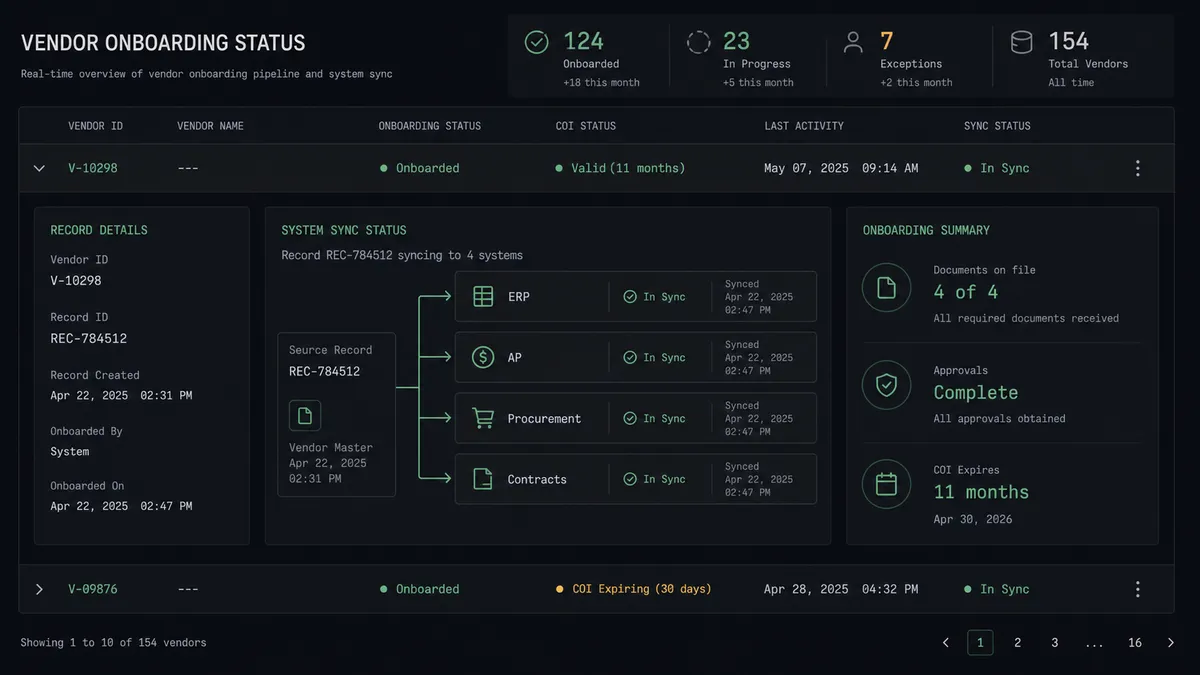
That work happens between systems, and none of the systems was built to own it. The intake form does not know what the ERP holds. The ERP does not know an approval is still waiting in someone’s inbox. This is the job an orchestration layer is for. An orchestration layer sits above your systems of record, listens for what each one produces (a submitted form, a signed agreement, an approval, an ERP write), and carries the context from one step to the next. It brings a person in at the decisions that need judgment and handles the routine moves between them.
FlowRunner is built for that layer. A vendor can fill in a FlowRunner form at its own link, with no login, and upload the W-9 and insurance certificate there. A flow can check your NetSuite or QuickBooks Online vendor list for a duplicate while the vendor is still filling in the form. When a decision is needed, the flow uses human-in-the-loop, an execution pattern where AI agents pause autonomously, assemble the relevant context and the decision choices available, route to a human via their preferred channel, and resume the moment the human responds. In practice the approver gets the request in Slack, email, WhatsApp, or by phone, can ask the flow for details before deciding, and the vendor record is written only after the answer comes back. The signed agreement can come back through DocuSign into the same run. The NetSuite vendor validation guide shows that pattern end to end, and the procurement automation and supplier relationship management pages show where it extends after onboarding.
Where to go from here
If you are new to vendor onboarding, the next useful read is the supplier onboarding process: seven steps, who owns each, and a checklist you can adapt. If your team already has a process and it feels slow or leaky, supplier onboarding best practices covers what to change first. If you would rather have the flow built for you, our implementation team can build it in your own FlowRunner workspace.
The definition to carry into either one: vendor onboarding is finished when the vendor can be paid safely and every system that references it holds the same record.
Frequently asked questions
What is vendor onboarding in simple terms?
It is the work of collecting, checking, and approving a new vendor's information, then setting the vendor up in your accounting or ERP system so you can send it a purchase order and pay its invoices. It starts when someone in the business asks for a new vendor and ends when that vendor can transact.
What is the difference between vendor onboarding and supplier onboarding?
Most companies use the two terms for the same process. Where a line is drawn, vendor onboarding means the administrative and financial setup for anyone you pay, and supplier onboarding adds operational readiness for suppliers of goods, such as delivery, quality, and order standards.
Who is responsible for vendor onboarding?
Procurement usually owns the process and the policy. Finance and AP own tax forms, banking details, and the vendor record in the ERP, legal owns the contract, and IT or security reviews vendors that will touch your systems or data. Each request still needs one named person who answers for where it stands.