How to Connect Stripe with CloudTalk (With or Without an AI Agent)
Connect Stripe payment events to CloudTalk so failed renewals become prepared outreach, with an AI agent that checks call history first and pauses for a human before a billing SMS reaches a customer's phone.
How do you connect Stripe to CloudTalk?
You connect Stripe to CloudTalk by having Stripe’s Parse Webhook Event trigger drive CloudTalk actions: a renewal payment fails, the workflow matches the customer with List Contacts or creates them with Add Contact, and reaches out with Send SMS or connects a rep through Make Call (Click to Call). FlowRunner is a visual AI-agent orchestration platform where automations run autonomously and pause for human judgment on the steps that carry real consequence. The same connection can run as an AI agent that prepares the outreach, checks the call history first, and pauses for a named human before any billing message actually reaches the customer’s phone.
The problem it solves
Right now your phone system and your payment system have never met. A renewal fails in Stripe, and the dunning emails go out into the void. The customers worth a phone call, the annual plans, the multi-seat accounts, the ones whose invoices fund payroll, get the same three automated emails as everyone else, because getting them to a rep means someone noticing the failure, looking up the number, checking whether anyone already talked to them, and dialing. By the time that happens, if it happens, the subscription has lapsed.
The edges are where trust erodes. A customer gets a billing text hours after they already fixed the card, because nobody checked. Another gets called twice in one day by two reps working from the same stale list. A third gets a payment reminder while they have an open complaint with support, turning a service problem into a cancellation. Billing outreach carries the least forgiveness of any message a business sends.
How it works: the connection
The connection listens to Stripe and drives CloudTalk. Here is the plain version, grounded in the real connector actions.
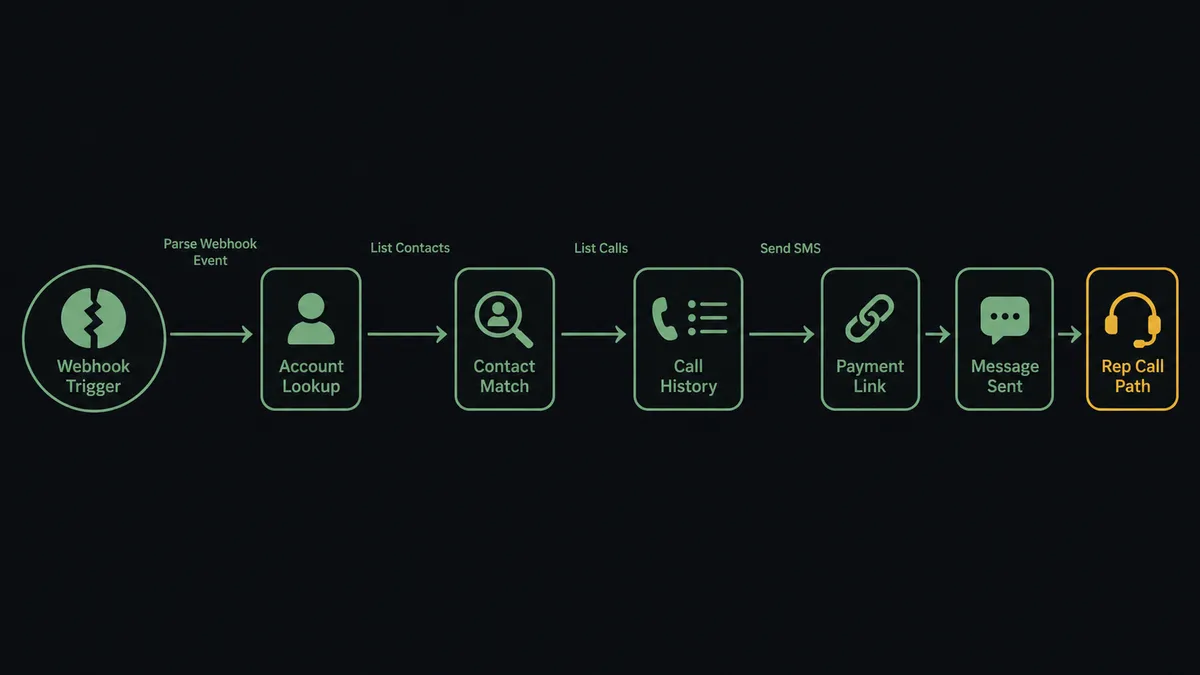
- Trigger: Stripe fires Parse Webhook Event when a renewal invoice payment fails at the connected endpoint.
- Read: The workflow calls Get Customer for the payer’s details and phone number, and Get Subscription for the plan and amount at stake.
- Match the contact: It calls List Contacts in CloudTalk, searching by phone and email, and Add Contact to create the record for a new customer, tagged for billing outreach.
- Check the history: It calls List Calls filtered to that contact and List Notes, so outreach never lands on someone who spoke to a rep yesterday.
- Prepare the fix: It calls Create Payment Link in Stripe so the message carries a working way to pay, not just a warning.
- Reach out: It sends the drafted message with Send SMS from your CloudTalk number, or, for accounts that warrant a conversation, queues Make Call (Click to Call), which rings an available rep from List Agents first and then dials the customer.
- Close the loop: When the payment event arrives, the workflow tags the contact resolved and logs the outcome, and Get Statistics feeds the weekly picture of how recovery outreach is performing.
That is the “just connect them” answer. Failed payments become informed outreach from your existing phone system, with the payment link attached and the contact record kept current.
Can an AI agent run it? (and why a human stays in the loop)
Yes, and the agent is the difference between a dunning cannon and a judgment call. The agent holds Get Customer, Get Subscription, List Contacts, Add Contact, Edit Contact, List Calls, List Notes, List Agents, Send SMS, and Make Call (Click to Call) as tools, and it reasons about each failure. A first decline two days before an automatic retry gets nothing but a watch. A high-value account with exhausted retries gets a drafted text and a proposed rep call. An account with an open support thread gets routed to that conversation instead of a billing ping.
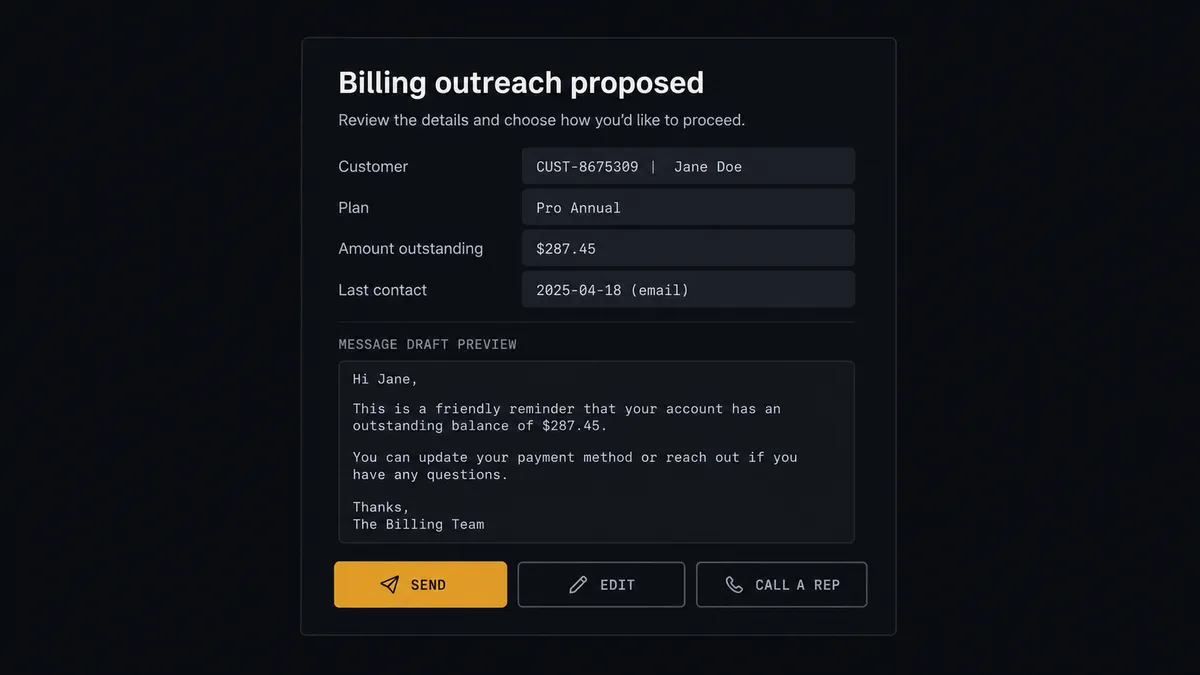
The consequential step is the moment a message leaves for the customer’s phone. A billing SMS is instant, personal, and impossible to recall, so Send SMS never fires on the agent’s judgment alone. The agent drafts the message, attaches the payment link, and invokes the human-in-loop flow it holds as a callable tool. The workflow pauses and posts: “Billing outreach proposed: [customer], [plan], [amount] outstanding, last contact [date and outcome from List Calls]. Message draft attached. Approve to send, or route to a rep?” A named approver sends it, edits it, or picks the call path, in which case Make Call (Click to Call) rings an available rep first and then dials the customer, with the account context already in front of them. The decision, the approver, and the timestamp land in the audit trail next to CloudTalk’s own call record.
This is the digital andon cord, the framing our own prospects gave us: like Toyota’s pull cord on the production line, the workflow stops the line before the step that touches the customer. The matching, the history check, and the drafting run untouched all day. The send button belongs to a person.
FlowRunner vs Zapier
Zapier can connect Stripe to CloudTalk, and its strengths are real: the category’s largest app directory, a template gallery that gets a notification Zap live in minutes, and the gentlest first-run experience for a newcomer. It also ships a native Request Approval step on paid plans, so a pause exists there too. Credit where it is due.
The difference is that this pair’s whole value is judgment before contact. Zapier’s approval is a fixed step acted on by a signed-in Zapier user inside Zapier’s interface; the same path runs for every matching event. FlowRunner’s agent decides per account whether outreach is warranted at all, checks the call history first, and puts the approval in the channel your team already reads, with the draft editable in place.
| What matters for this pair | FlowRunner | Zapier |
|---|---|---|
| Human-in-the-loop on Send SMS | Native. The agent invokes an approval flow as a callable tool before any message reaches the customer | Native Request Approval step on paid plans; the reviewer signs in to Zapier to act on it |
| Who runs the flow | An AI agent weighs each account and decides text, rep call, or nothing yet | A step sequence you configure; every matching event follows the same path |
| Users included | Unlimited users on every tier | Per-seat pricing until Enterprise |
| Bring your own AI keys | Yes, BYOK | AI runs through Zapier’s own AI products and billing |
| Self-hosted option | Yes, cloud-hosted or self-hosted | Cloud only |
| Pricing model | Transparent workflow-based tiers, priced per execution | Per-task; each action step in a run consumes a task |
If all you need is “failed payment posts a notification,” Zapier does that well. If billing outreach from your phone system should be decided account by account and released by a named person, this pairing is where FlowRunner is the better fit.
Before and after
| Category | Before | After |
|---|---|---|
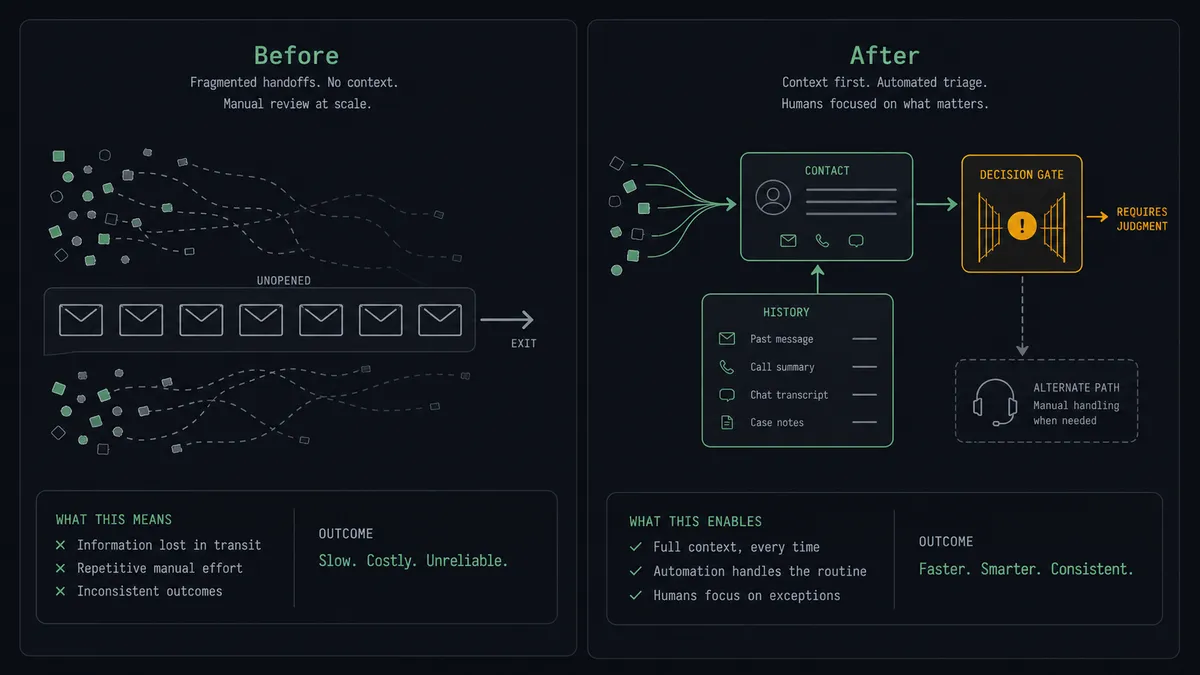
| Failed renewals | Three automated emails, then silent churn | High-value failures become drafted outreach with the payment link attached |
| Contact context | Reps dial from stale lists without the payment picture | List Calls and List Notes are checked before any outreach is proposed |
| Double contact | Two reps call the same customer from the same list | The history check catches recent contact before anything is queued |
| Message control | Automated texts fire on triggers nobody reviews | A named approver releases, edits, or reroutes every billing SMS |
| Rep handoffs | The rep gets a number and no story | Make Call (Click to Call) connects an available rep with the account context prepared |
What you can build
Dunning outreach desk. Parse Webhook Event fires on a failed renewal, the agent matches the contact, checks List Calls, drafts the message with a Create Payment Link attached, and a named approver releases Send SMS.
Rep-connected saves. For accounts worth a conversation, the approver picks the call path and Make Call (Click to Call) rings an available rep from List Agents, then dials the customer with the account story prepared.
New-customer welcome contact. A first payment creates the CloudTalk record with Add Contact, tagged and numbered in E.164, so the phone system knows every paying customer before the first support call.
Cancellation follow-up queue. A subscription cancellation event proposes a retention call with tenure and plan context, gated by the same approval, so saves are attempted by conversation rather than exit survey.
Recovery performance digest. A scheduled flow pulls Get Statistics and recent List Calls activity for the billing tag and posts a weekly summary of outreach volume, answered calls, and recovered payments to your team’s channel.
Common questions
Is it free to connect Stripe and CloudTalk on FlowRunner? You can build and run the connection on FlowRunner’s free plan, which includes 100 executions a month and every integration with no credit card required, and new accounts also get 14 days of Professional. Both connectors are available on every FlowRunner tier, and every tier includes unlimited users and unlimited workflows.
Can I self-host the Stripe to CloudTalk workflow? Yes. FlowRunner offers a cloud-hosted option and a self-hosted option, so the connection can run inside your own environment.
Does the AI agent need my own OpenAI or Claude key? FlowRunner uses a bring-your-own-keys model, so you connect the AI provider key you already have. You are not locked to one model.
What happens when the agent is unsure whether a customer should be contacted at all? The agent checks List Calls and List Notes for recent contact history before proposing anything. When the history shows a recent conversation, an open complaint, or anything ambiguous, it does not queue outreach. It posts the account summary to your team and waits for a person to decide whether contact is appropriate.
Which Stripe events can trigger a CloudTalk action? Stripe uses a single trigger, Parse Webhook Event, which receives every Stripe event type from a connected webhook endpoint. For this pair, failed invoice payments, subscription cancellations, and high-value checkouts are the events teams usually route into outreach, and the agent branches on the event type it receives.
How does Make Call (Click to Call) connect a rep to the customer? Make Call (Click to Call) rings the specified CloudTalk agent first, and once they answer it dials the destination number. The rep must be online and available, which is why the workflow checks List Agents before queuing the call, and destination numbers need E.164 format.
Getting started
Start on the free plan: 100 executions a month, every integration included, no credit card required, plus 14 days of Professional for new accounts. Both connectors are available on every tier, and every tier includes unlimited users and unlimited workflows, so billing and the phone team share the same recovery desk from day one.
Explore the integration details:
- Stripe integration (1 webhook trigger and 67 actions across payments, subscriptions, invoices, refunds, and payouts)
- CloudTalk integration (15 actions across calls, SMS, contacts, agents, and statistics)
Start building free at flowrunner.ai or book a demo to see a live Stripe to CloudTalk workflow, outreach approval and all.
Frequently asked questions
Is it free to connect Stripe and CloudTalk on FlowRunner?
You can build and run the connection on FlowRunner's free plan, which includes 100 executions a month and every integration with no credit card required, and new accounts also get 14 days of Professional. Both connectors are available on every FlowRunner tier, and every tier includes unlimited users and unlimited workflows.
Can I self-host the Stripe to CloudTalk workflow?
Yes. FlowRunner offers a cloud-hosted option and a self-hosted option, so the connection can run inside your own environment.
Does the AI agent need my own OpenAI or Claude key?
FlowRunner uses a bring-your-own-keys model, so you connect the AI provider key you already have. You are not locked to one model.
What happens when the agent is unsure whether a customer should be contacted at all?
The agent checks List Calls and List Notes for recent contact history before proposing anything. When the history shows a recent conversation, an open complaint, or anything ambiguous, it does not queue outreach. It posts the account summary to your team and waits for a person to decide whether contact is appropriate.
Which Stripe events can trigger a CloudTalk action?
Stripe uses a single trigger, Parse Webhook Event, which receives every Stripe event type from a connected webhook endpoint. For this pair, failed invoice payments, subscription cancellations, and high-value checkouts are the events teams usually route into outreach, and the agent branches on the event type it receives.
How does Make Call (Click to Call) connect a rep to the customer?
Make Call (Click to Call) rings the specified CloudTalk agent first, and once they answer it dials the destination number. The rep must be online and available, which is why the workflow checks List Agents before queuing the call, and destination numbers need E.164 format.