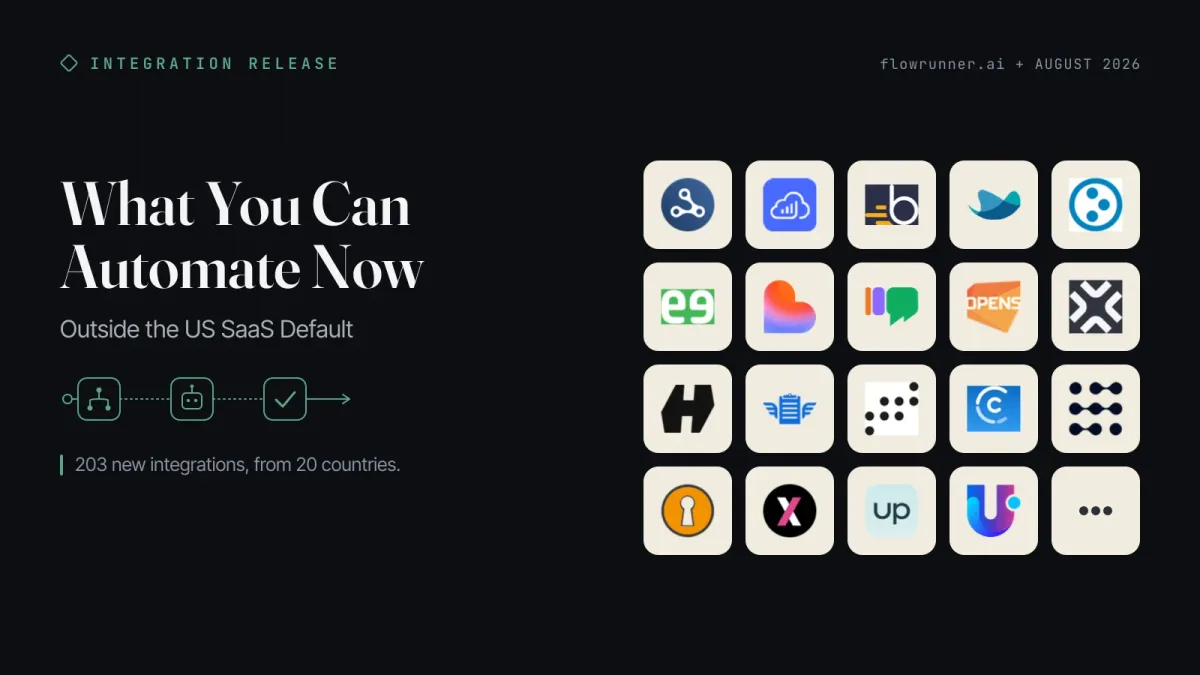
An automation platform’s integration list is a map of where its customers are, and for most of this industry that map has one country on it. That is the honest read nobody in automation publishes: the long tail of “unsupported” business software is not obscure, it is just not American. A French agency runs Axonaut and Bleez. A Czech sales team runs RAYNET. A Brazilian inside-sales floor runs Meetime and Agendor. Those are not niche tools. They are the systems those businesses actually run on, and the usual path to automating them is a generic HTTP node, an API reference you may not read in your first language, and a weekend.
203 new connectors landed in FlowRunner this week, taking the catalog to 1,500 services. 55 of them name a specific country or region in their own documentation, across 20 countries: France, Germany, Brazil, Czechia, Poland, Slovakia, Italy, Switzerland, Denmark, Sweden, Ukraine, Israel, Romania, Mexico, India, Vietnam, and more. Every one is built and verified against that vendor’s own API, the same way as every connector before it.
This is where the argument gets past the release note. A team in Lyon or Brno is not asking for a longer list. They are asking for the same thing a team in Austin asks for: a layer that sits above their systems of record, listens to what those systems emit, gathers the context the record does not carry, and pulls a person in at the moment something gets committed. That layer is a category, orchestration as a service, and its defining property is indifference to where a system happened to be built. FlowRunner is built for that layer, which is why a Slovak CRM lands in the same runtime, with the same audit trail and the same human-in-the-loop step, as Salesforce. Human-in-the-loop is an execution pattern where AI agents pause autonomously, assemble the relevant context and the decision choices available, route to a human via their preferred channel, and resume the moment the human responds. It does not get a local variant.
One honest note before the flows, because release posts skip it and builders find out later. Most connectors in this wave are read and write, not event sources. Where a tool exposes no event stream, the flow runs on a schedule or a cursor poll, which for these workloads is the right shape anyway. Where a tool genuinely emits events, like Channex and apaleo below, the flow starts the moment something happens, and I say so.
Here are seven flows you can build today. Every tool named is a real FlowRunner connector, and in each flow the step that carries real consequence stays with a human.
Run a French quote-to-cash cycle without retyping it into the ledger
Every morning, an agent lists opportunities in Axonaut, picks up the ones marked won since yesterday, raises the matching quotation, and once the client accepts, creates the invoice and records the payment against it. On the Sellsy side the same cycle runs through estimates: the agent moves the estimate status as the deal progresses and keeps the company, contact, and opportunity records aligned. The accounting tail lands in Bleez as a journal entry, with the source document uploaded into the dossier and the account balances read back for the reconciliation. The step that stops is Sellsy’s invoice validation. A validated French invoice is a legal document with a sequential number, and the connector exposes no way to un-validate one, so the agent assembles it and the person who owns the numbers presses validate.


Convert a Czech lead without spawning a duplicate account
Every hour, an agent pulls the new leads in RAYNET, checks each one against existing accounts so a returning customer does not arrive as a fresh name, and creates the follow-up task that keeps the activity trail honest. Converting the lead is what spawns an account, a contact, and a deal in a single move, and untangling that afterwards is manual work, so the agent presents the candidate matches side by side and a person decides. For the half of the team that lives in Outlook, the same run writes the deal and its history into eWay-CRM as a journal entry against the company, so nobody has to switch tools to see what happened.


Close the loop between a Brazilian call floor and the CRM
Every evening, an agent pulls the day’s calls and prospecting activity from Meetime, reads each call summary, and writes the outcome into Agendor: upsert the person and the organization, move the deal to its new stage, create the next task. Prospects who went quiet get added back into the right cadence instead of dying in a rep’s notebook. Moskit CRM takes the same shape if that is your stack, with the summary filed as a deal note. The outbound WhatsApp message through Yunique is where it stops. A message landing on a prospect’s personal number under a rep’s name is a relationship decision, so the agent drafts it with the full call history attached and the rep sends.


Dispatch a German trades crew on evidence, not on a phone call
Every fifteen minutes, an agent lists the open work requests in remberg, pulls the asset’s service history and its failure types, checks whether the parts are actually in inventory, and posts the whole packet to whoever schedules the week. Approving a work request commits a crew, a truck, and stock, so that approval stays with a person looking at a complete picture rather than a one-line ticket. On approval the agent opens the work order, and on the next pass it reads the forms the technician filed, files the site photos into the right MemoMeister project folder with labels applied, and saves the signed document against the job in HERO Software. The documentation gets done because nobody had to remember to do it.


Turn anonymous website traffic into a contact you are allowed to email
Every morning, an agent reads the previous day’s intensive and returning visits from Webmetic, enriches the company behind each one, and for the visits that match your profile creates or updates the contact in 4leads with the firmographics written into custom fields and a tag applied for segmentation. What the agent does not do is start the campaign. Enrolling someone in a mail sequence is the step that needs a lawful basis under GDPR, so the agent reads the opt-in case, finds nothing, and stops. A person decides whether this signal is warm enough to send an opt-in request at all. Consent is a judgment about a relationship, not a checkbox an agent gets to tick on your behalf.


Take a booking from any channel through to a self-check-in
This is the flow that starts on a real event. Channex fires the moment a booking lands from a connected booking site. The agent creates the matching booking in Chiavistello so the guest’s self-check-in is provisioned, raises a hosted payment request for the balance and the tourist tax, pushes updated availability and rates back across the channels so the room does not double-sell, and issues the fiscal receipt Italian hospitality requires once the payment clears. On the hotel side, apaleo drives the same shape from its own event stream: assign the unit, check the reservation in, post charges to the folio, add the payment. Then it is one in the morning and a guest is standing outside a door that will not open. The agent assembles the booking, the payment status, and the ID on file into one message, and a person decides whether to open that lock remotely. Opening a door for whoever is currently asking is the definition of a call you want a human on.


Onboard a regulated client and let a named person approve them
A new client signs. The agent creates the account and contact in Xama, initiates the onboarding and AML reports, and opens an IdentityCheck verification that invites the client into a hosted capture session. Worth knowing before you build it: IdentityCheck returns its verdict to a webhook endpoint you configure in its own dashboard rather than to a FlowRunner trigger, so the flow polls for the captured media and picks up the decision from wherever you route it. When the risk assessment lands, the agent pulls it with the supporting documents attached. Moving that account to approved status is a regulated decision, so it waits for the person whose name is on the file. In Israel, Surense runs the same shape one step earlier: before a flow places business with an agent, it checks the licensee is valid and halts if the registry disagrees.


Build one of these next
Seven flows does not cover twenty countries. Upsales in Sweden, Livespace in Poland, FLOWii in Slovakia, Uspacy in Ukraine, Bind ERP in Mexico, Persat across Latin America, and BoondManager and SingleCase for consulting and legal practices all landed in the same wave, and every one of them composes the same way. Browse them on the CRM and sales hub, the finance and accounting hub, or the full integrations directory, and see how builders wire them together on the developers page.
The point of a wave like this is not that the catalog got bigger. It is that the question “does it support the software we actually run?” stops being the first thing you have to ask, and the flow you wanted to build becomes something you compose in an afternoon rather than something you argue for in a budget meeting.
This is the fourth in our weekly roundup of what the newest integrations make possible. Last week was 570+ new integrations, before that 30+ AI providers, and before that the new core connectors. More soon.