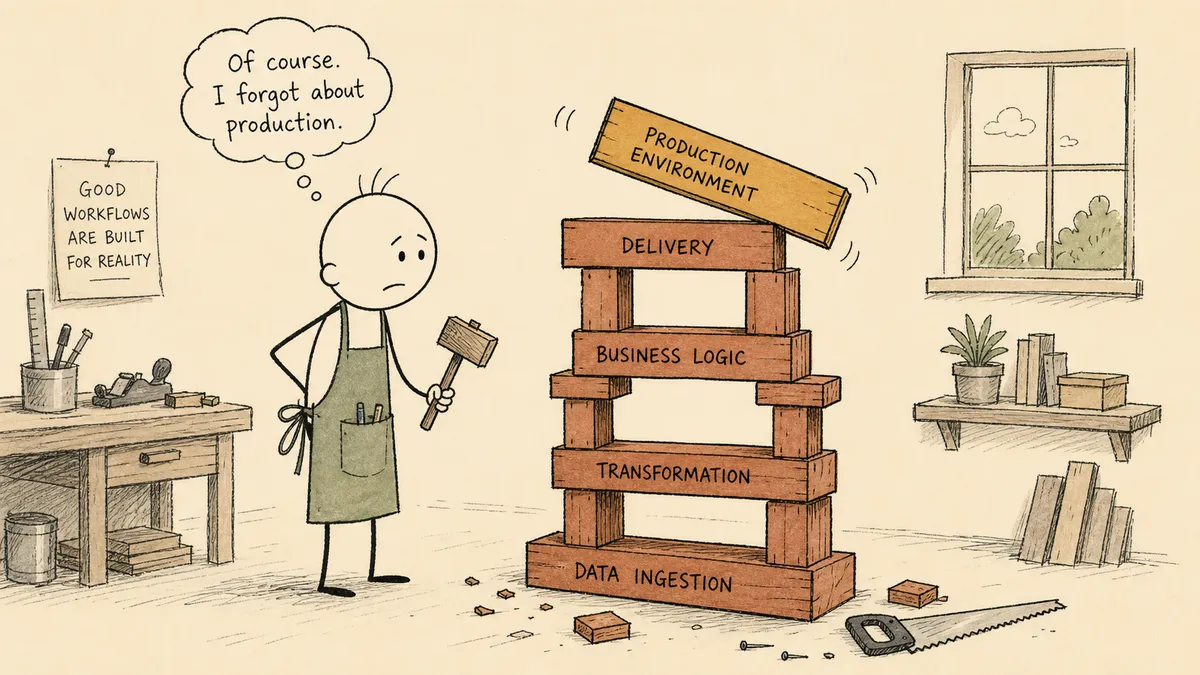
Automations look great in demos. They run perfectly in test environments. But when they hit real business data, real edge cases, and real production loads, they break. The cost is real: lost prospects, missed financial records, and operations staff babysitting broken workflows.
The Hidden Lifecycle of Fragile Automations
There’s a recurring pattern. Initial workflows perform well during testing, but failures show up shortly after deployment. Common failure modes include:
- Missing required data fields causing prospect loss
- Incompatible file uploads triggering system crashes
- Rate limiting causing silent record skipping
These breakdowns come from insufficient safeguards. No retry mechanisms, no error management, no notification systems. Most automations are built for the happy path. Real-world complications don’t follow the happy path.
Business Impact Across Roles
Different stakeholders feel this differently:
- Leadership: Capital allocated toward automations that don’t deliver
- Operations: Extensive manual intervention required to repair workflows
- Consultants: Difficulty demonstrating measurable business value
Why Hacks Don’t Hold Up
The core problem isn’t the tools. It’s the lack of engineering discipline. Professional software development incorporates error handling, monitoring systems, and resilience patterns that automation typically overlooks.
A Framework for Building Automation That Lasts
Five implementation stages can change this:
- Audit - Identify workflows and cost inefficiencies
- Blueprint - Design with safeguards and exception handling
- Patterns - Deploy reusable structures
- Build - Prioritize revenue impact
- Package - Create scalable, reusable assets
Engineering Principles That Hold Up
Reliability requires foundational engineering principles established from project inception. You can’t bolt on resilience after the fact. You have to design for it from the start.
Approaching Automation as a Science
Sustainable automation requires systematic thinking rather than improvisation. Treat automation as engineering, not experimentation, and you transform brittle scripts into reliable, scalable business infrastructure.